
Communities

McConnell Hub Logo

Communities focus area

Supporting communities has been central to the McConnell Foundation since our founding in 1937. In 2021, we launched a dedicated Communities focus area, with a goal to support communities to take the lead in addressing challenges they face at a systemic level. On this page, you will find information about our Communities funding priorities and eligibility criteria for potential applicants. 

Temporary Closure of the Communities Application Portal

Due to a high volume of proposals received, the application portal for the Communities focus area is currently closed.

This temporary pause will allow our team to carefully review the proposals already submitted. Because the proposals already under consideration exceed the resources we can allocate for Communities this year, we want to be respectful of your time and avoid inviting proposals we cannot yet consider.

Updates about reopening the portal will be announced later this year on our website. You can also sign up for our mailing list if you wish to receive updates directly to your mailbox.

We thank you for your understanding and for your continued interest in the Communities focus area.

Our Approach

We see community as a group that shares common barriers, needs, and goals, whether defined by geography, identity, interest, or other commonalities.  

Our communities focus area aims to partner with equity-denied groups to support their path toward greater equity and justice. An equity-denied group refers to those whose access to resources, opportunities, or social benefits has historically been denied due to systemic inequities. 

We also acknowledge the importance of intersectionality: the experience of interconnected forms of discrimination, acknowledging that people live with overlapping social identities such as race, gender, class, sexual orientation, ability, and religion. 

What we fund

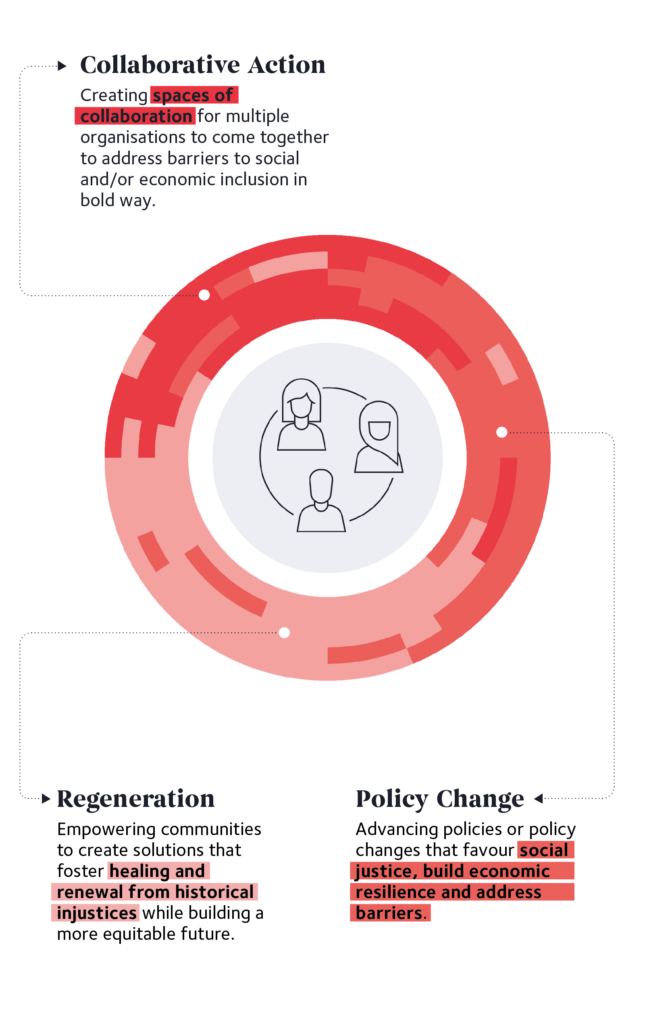
Circular image depicting three people in the centre, with arrows pointing to each of the Communities Focus Area's funding streams
Line drawing of a woman in a hijab, an unveiled woman, and a man, surrounded by a red version of the McConnell circular logo. Connected to the circle are descriptions of the Communities funding strategies: Collaborative Action (creating spaces of collaboration to address barriers to social and economic inclusion) and policy change (advancing policy changes that favour social justice).

We want to help fund activities that support collaborative action, policy change and regeneration, helping to address barriers to social and economic inclusion. Learn more below.

$7.71M

in contributions

We supported 53 organizations in 2024, allocating over $7 million in funding to partners looking to accelerate and amplify positive change in their communities.

Our funding streams 

We seek to support initiatives that have community at the heart of their actions and purpose. It is important to ask: how is the project fostering long-term systemic positive outcomes for the community? 

Our role as a national funder is to offer our resources as a lever to address the root causes of inequity at a meaningful scale. As such, we are looking to help fund activities that fall into one of the following categories: 

  • Collaborative action: creating spaces of collaboration for multiple organizations to come together to address barriers to social and/or economic inclusion in a bold way. We want organizations to reach together to accomplish audacious goals that they are less likely to achieve on their own.
  • Policy change: advancing policies or policy changes that favour social justice, build economic resilience and address barriers. We will support policy change efforts at all stages: from advocacy to engagement, communication, consultation and priority setting.
  • Regeneration: supporting communities in their capacity to develop solutions that enable recovery from historical harm. Regeneration involves processes of renewal, restoration, and growth—particularly in communities that have faced systemic damage or loss. This pillar allows us to fund groups rooted in a deep understanding of history, focusing on local innovation to rebuild a more equitable future. 

We recently updated our funding strategy. To learn more, watch our webinar, where we outline the key updates and details of our approach. For details on the questions and criteria for each funding strategy, please refer to our sample application form.

What we do not fund

We do not fund frontline services or running day-to-day services or programs. For example, we do not fund food banks, shelter programming, mental health counseling, food production or distribution, health care for people or animals, drop-in centre programs, support groups, art therapy, training, workshops, or other ongoing community services delivery. 

We also do not fund work that takes place outside of Canada. 

Other things we cannot support include:  

  • Academic research 
  • Renovation or purchase of a building 
  • Conference attendance  
  • Fellowships 
  • Event sponsorship  

For more detail on the criteria, please refer to our Eligibility Quiz here.

Key Considerations in Making Funding Decisions

The belief that communities have the best understanding of the challenges they face and their potential solutions grounds the following considerations. When reviewing applications, we consider the following:   

  • Nothing About Us Without Us: This focus area prioritizes work that rebalances power and centers communities in addressing their own needs. We aim to partner with and strengthen organizations and networks that reflect the communities they serve.   
  • Focus on racialized groups and intersectionality: Racialized groups are disproportionately affected by systemic issues. We will pay particular attention to supporting their work to confront their unique barriers and foster justice, acknowledging how intersectionality shapes experiences within and across communities.   
  • Projects that Challenge the Status Quo: We support groups that challenge societal norms and confront existing systems, embodying McConnell’s principle of boldness to foster creativity and innovation.   
  • Collaborative engagement: We recognize that isolated efforts rarely have the capacity to influence the systems affecting equity-denied communities. Collective action, whereby organizations collaborate and leverage each other’s strengths, has been consistently identified as a critical approach for creating meaningful change.  
  • Allocating Resources to “Underfunded” Groups: We intentionally support groups traditionally overlooked in philanthropy to challenge conventional thinking and promote equity and innovation, aligning with our commitment to fairness and recognizing the diverse starting points and aspirations of different communities.   
  • Work Aimed at Dismantling Racism and Colonialism: We aim to fund initiatives that help to confront and dismantle the barriers of racism and colonialism.   
  • Building “Social Infrastructures”: We aim to support community-driven systems that ensure sustainable benefits for future generations. 
  • Projects that are clear and specific: We aim to support organizations that are engaged on changing systems through work that is clear and specific.

Recent funding

Funding will expand legal and policy advocacy to improve harm‑reduction access, protect health rights and strengthen community‑driven efforts supporting people who use drugs across Canada.

$ 100,000 2026 - 2028

Funding will support a Partnership Lab helping housing providers collaborate, share resources and form mergers that strengthen operational stability and preserve affordable housing in Winnipeg.

$ 435,000 2026 - 2028

Funding will train emerging technicians with green construction skills, expanding pathways for equity‑deserving communities and building a diverse, job‑ready workforce across Ontario and Nova Scotia.

$ 385,000 2026 - 2028

Funding will help launch new refugee‑owned worker co‑ops, strengthen existing ones, and build long‑term economic resilience and democratic ownership within migrant and refugee communities.

$ 375,000 2026 - 2028

Funding supports cultural restoration, energy transition planning, and land stewardship in one of Nova Scotias oldest African Nova Scotian rural communities.

$ 600,000 2025 - 2029

Funding supports land transfer, cultural preservation, and community healing in Truro’s historic African Nova Scotian settlement.

$ 325,000 2025 - 2029

Learn more about how to apply for Communities funding on our "For Applicants" page.